

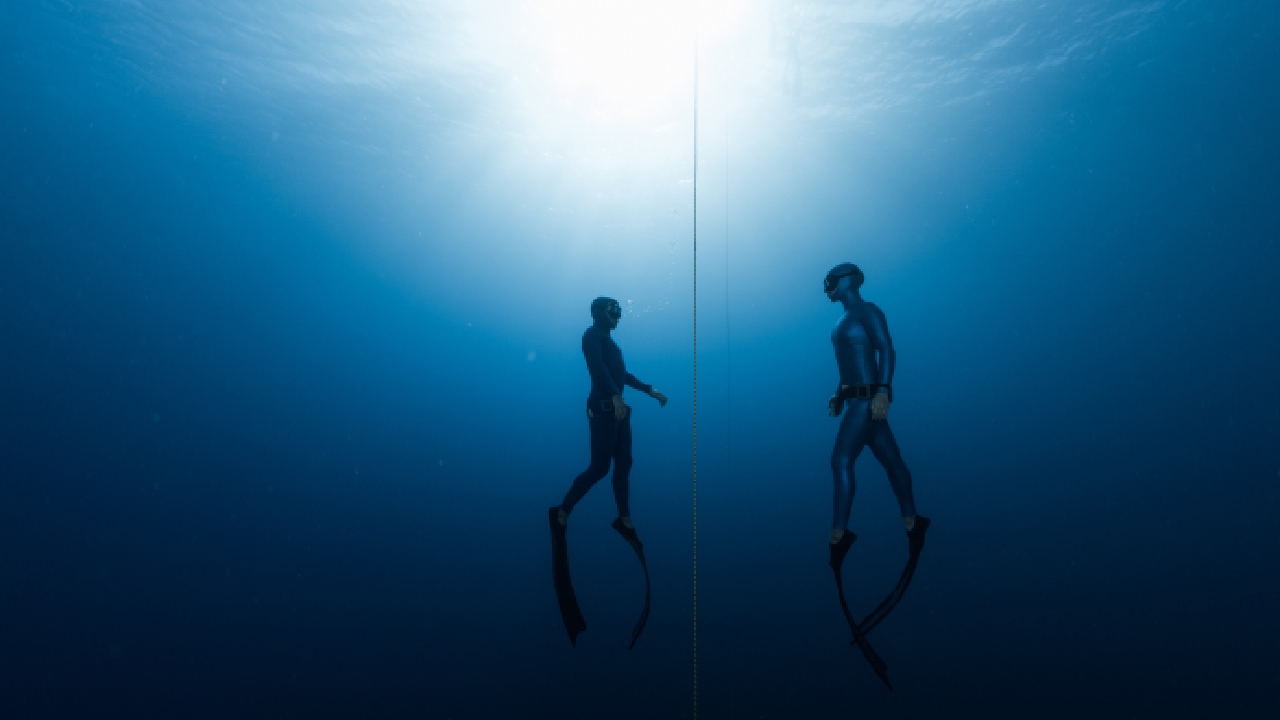
Vogue recently called freediving the ultimate wellness reset, and Slate profiled everyday people learning to hold their breath past the point once thought lethal. An extreme sport has quietly become one of the most talked about ways to switch off.
Of course, we’ve known this for years, quietly watching newcomers walk away calmer and more confident after every course. It’s satisfying to see that knowledge finally reaching the mainstream, backed by the same science we’ve built our teaching around.
This guide explains why freediving for beginners is having a moment, what happens physically and mentally on your first breath-hold, and how to start safely. By the end, you will understand why so many people are hooked.
What Is Freediving for Beginners?
Freediving for beginners means learning to swim underwater on a single breath, using relaxation, technique and safety protocols rather than raw lung capacity. A typical beginner course teaches breath-hold basics, equalisation, buoyancy and buddy safety over a weekend, taking most divers from nervous first breath-holds to comfortable dives of ten to twenty metres by the final session.
From Extreme Sport to Everyday Reset
Freediving used to be framed as an extreme pursuit reserved for record chasers and free spirits. That image is fading fast, with wellness travel guides and mainstream outlets now pitching a weekend breath-hold course alongside yoga retreats and cold plunges.
That shift is well documented. Slate recently described freediving moving from an extreme test performed by a select few into something anyone curious enough can try, with Vogue even pitching it as a wellness reset.
That shift matters here in Australia too, where beginners increasingly come to us for calm and headspace as much as adventure. The dive reflex your body already carries is exactly why this style of stress relief works so well.
- Makes you wonder if Vogue had been talking about our 7-Day Freediving Adventure Trip to Bali, where freediving sits alongside yoga, breathwork and ice baths.
Your Body Already Knows What to Do
Much of the anxiety around a first breath-hold comes from not understanding what is happening physiologically. The body carries an ancient set of reflexes that switch on the moment your face touches water, working in your favour from session one.
- Facial immersion in cool water
- Increasing pressure at depth
- Rising carbon dioxide, not falling oxygen, which is what actually creates the urge to breathe
This response, the mammalian dive reflex, is exactly why first-timers often surprise themselves with how long they can comfortably hold on. Our guide to the science behind it explains the physiology in more depth.
The Mental Health Case for Freediving
Freediving’s wellness reputation is not just marketing. Recent research is starting to back up what instructors have long noticed anecdotally, that something about controlled breath-holding underwater genuinely settles the nervous system and quiets an anxious mind.
A European survey reported by DeeperBlue this year found a significant link between underwater diving and psychological wellbeing in young adults, part of a project backed by Erasmus+ and Divers Alert Network Europe.
A separate systematic review of breathing-based interventions, published in the journal Brain Sciences, found regular breath-hold and slow-breathing practice reduced anxiety, lowered cortisol and improved stress resilience over time.
None of this means freediving replaces professional care, but it does help explain why so many beginners describe their first course as calming rather than terrifying. The water, it turns out, is doing some of the work for you.
Bek Nutter, a member of Australia’s National Freediving Team, once wrote that freediving taught her to sit with fear instead of running from it. That lesson followed her onto land as much as underwater. In June 2026 she swam the furthest distance underwater on a single breath by an Australian woman in competition, setting four Oceanic Continental Records in the process.
- Women have shaped freediving from the very beginning. Read more in our piece on freediving’s female pioneers, or find your own version of that courage on our All Girls Freediving Adventure Retreat in Fiji.
What Your First Freediving Session Looks Like
A beginner course is far more structured than most people expect. Instructors build confidence gradually, starting on land and in the shallows before easing you into open water dives with full safety supervision.
- Breathing and relaxation techniques practised on dry land first
- Static breath-holds in shallow water to build comfort
- Basic equalisation to manage pressure in the ears
- Supervised open water dives to depths of ten to twenty metres
- A qualified buddy alongside you for every dive
Most beginners leave their first course with a personal best breath-hold they never thought possible, and a level 1 certification recognised worldwide. Our guide on preparing for your first freediving course covers what to bring and how to get ready.
Finding Your People
Part of freediving’s appeal is social, not solitary. Courses and trips introduce you to a community that already treats safety, breath work and ocean time as shared rituals rather than solo pursuits.
Every certified diver is taught to never dive without a buddy, which naturally builds a tight, safety-first community around the sport. Read more about why a good freediving buddy matters so much once you start training regularly.
Ready to Try Freediving for Beginners?
Freediving for beginners is no longer a fringe pursuit reserved for the fearless. It is a genuinely accessible, well-supported way to build confidence in the water and quiet a busy mind.
If this has sparked your curiosity, browse our courses to find a beginner-friendly session near you, or get in touch and we will help you find the right first step.